
httpbin.org, Flasgger, and the Real Test for Scaling Flask API Documentation in Malaysia

A Flask team reviews how Flasgger supports the documentation layer behind an API service.
httpbin.org 0.9.2 is publicly presented as “A simple HTTP Request & Response Service” and is marked as powered by Flasgger; the Python extension behind the API documentation layer is Flasgger, not httpbin.org itself.
For Malaysia-based Flask teams, the useful question is therefore not whether httpbin.org offers a nicer Swagger page, but whether Flasgger’s OpenAPI specification can become the shared source for documentation, request validation, and large-API file organization.
The overlooked point is governance. Once a Flask API grows beyond inline notes in view functions, the documentation page becomes a by-product; the operating asset is the OpenAPI spec.
1. Trend data: the hard signal is architectural, not adoption-based

Publicly available material in the supplied sources does not provide Malaysia-specific adoption numbers for Flask, OpenAPI, Swagger UI, or API documentation tools. The absence of Malaysia-specific adoption numbers matters: this market should not be analysed through popularity claims. The stronger evidence is in the feature boundary.
The official httpbin.org page identifies the service as httpbin.org 0.9.2 and describes it as a simple HTTP request and response service.
The same page indicates that it is powered by Flasgger. Flasgger’s own positioning is “Easy OpenAPI specs and Swagger UI for your Flask API,” according to its official GitHub repository.
Those source claims give a clean separation:
| Entity | What the supplied material supports | Practical implication |
|---|---|---|
| httpbin.org 0.9.2 | A simple HTTP request and response service, useful for echoing HTTP traffic, debugging HTTP clients, and testing webhooks | It is a public HTTP testing service, not primarily the documentation extension |
| Flasgger | A Flask extension for OpenAPI specs, Swagger UI, and request validation | It is the component relevant to API documentation and validation decisions |
| Swagger UI | Interactive documentation interface, including routes such as /apidocs in Flasgger usage |
It is the visible layer, but not the whole value of the stack |
| OpenAPI Specification 2.0 | The main supported specification style in the supplied material | It anchors the documentation and validation contract |
| Swagger UI 3 / OpenAPI 3.0 | Described as experimental in the supplied material | Teams should treat OpenAPI 3.0 support as a boundary, not the default assumption |
The second-order conclusion is simple: a Flask team evaluating “httpbin.org as a Python extension” is probably asking about Flasgger.
httpbin.org demonstrates a service powered by Flasgger; Flasgger is the extension that turns Flask views, specs, schemas, and validation into a documentation workflow.
For MY teams running lean API stacks, this distinction is not academic. If the buying or architecture question starts with “Which tool gives us a Swagger page?”, the team will underweight the parts that reduce long-term drift: external YAML, schema reuse, validation hooks, and deployment-aware configuration.
2. Why docstrings stop carrying the API once the surface area grows
httpbin.org与同类平台的关键维度横向对比。
Flasgger supports specification extraction from Flask views, MethodView, and class views. It also supports several specification sources: docstrings, external YAML files, Python dictionaries, Marshmallow Schema, and the swag_from decorator.
Flasgger’s breadth of supported specification sources is the signal. A tool does not need docstrings, external YAML, dictionaries, decorators, and schema integration if the intended use case is only a small demo API.
The practical inflection point appears when inline docstrings become a maintenance risk. In a small Flask application, putting the API description beside the route handler is convenient. The route, the human-readable description, and the example response live in one place. The maintenance cost arrives later: long docstrings crowd the view function, repeated schema fragments drift across endpoints, and reviewers must inspect code files to understand contract changes.
External YAML changes that operating model. Flasgger can load specs through swag_from or docstring file shortcuts. It can also organise external spec files by endpoint and HTTP method. Endpoint-and-method-based external spec organisation is a structural feature for larger API surfaces because it lets teams separate the contract file from the Python function without disconnecting it from runtime documentation.
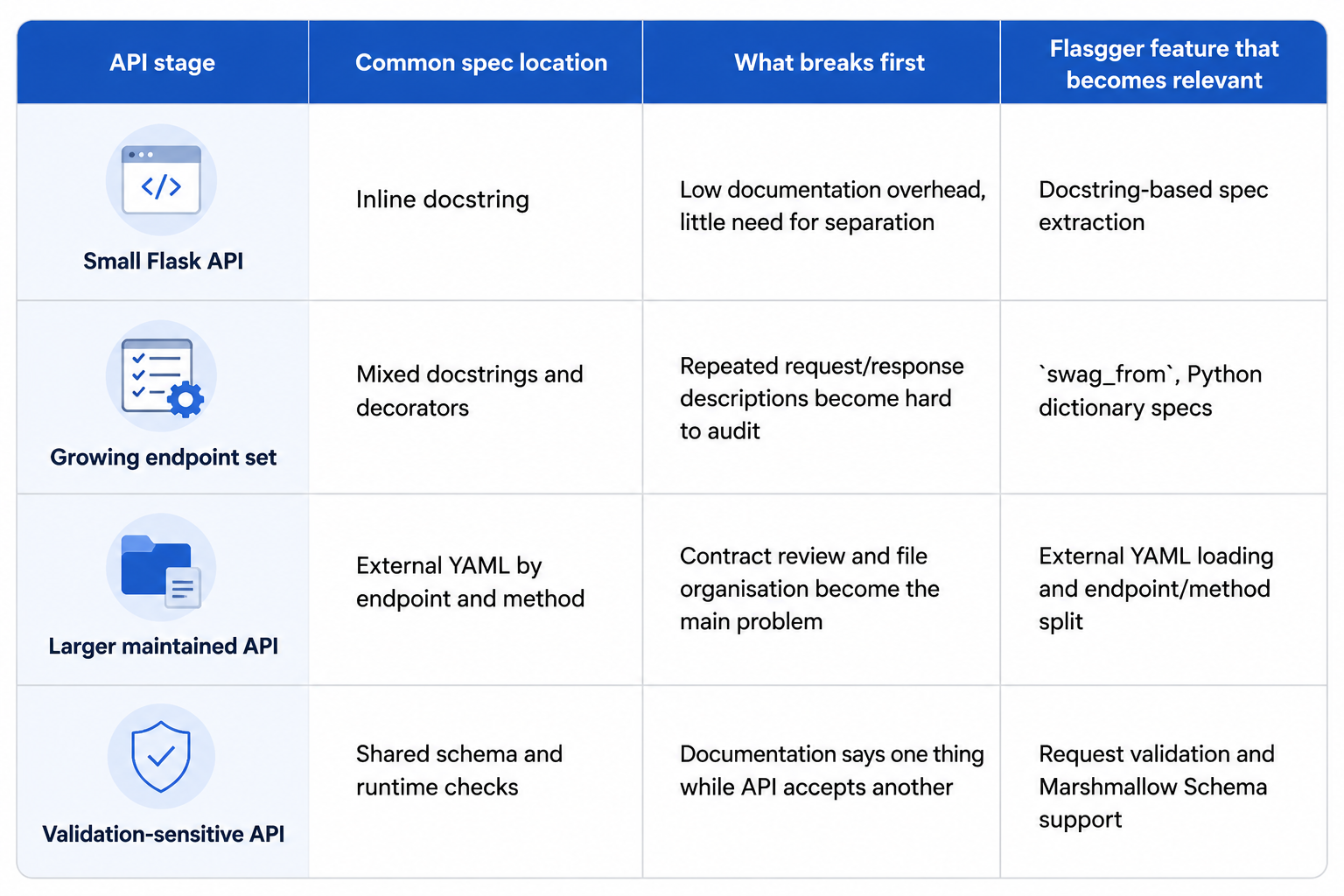
A compact way to read the progression:
| API stage | Common spec location | What breaks first | Flasgger feature that becomes relevant |
|---|---|---|---|
| Small Flask API | Inline docstring | Low documentation overhead, little need for separation | Docstring-based spec extraction |
| Growing endpoint set | Mixed docstrings and decorators | Repeated request/response descriptions become hard to audit |
swag_from, Python dictionary specs |
| Larger maintained API | External YAML by endpoint and method | Contract review and file organisation become the main problem | External YAML loading and endpoint/method split |
| Validation-sensitive API | Shared schema and runtime checks | Documentation says one thing while API accepts another | Request validation and Marshmallow Schema support |
The important judgement: external YAML is not automatically better than docstrings. It is better only when the API contract has become large enough that file organisation, reviewability, and reuse matter more than keeping everything inside the view function.
Flasgger’s validation capability changes the economics again. The extension can validate request data for methods such as POST, PUT, and PATCH. It uses the same API specification family that powers the documentation view. That turns the spec from a descriptive artifact into an enforcement layer.
For teams handling internal dashboards, fintech-adjacent workflows, logistics integrations, or webhook-heavy services in Malaysia, this is the point where documentation tooling becomes governance tooling. The visible Swagger UI page is helpful, but the stronger value is reducing the gap between what the API claims and what the API accepts.
3. Main players: the useful comparison is by operating model, not brand list

The practical comparison for Flasgger is its operating model inside a Flask team’s workflow.
Flasgger is a lightweight Flask extension that connects Flask runtime code, OpenAPI/Swagger documentation, and request validation.
It should not be evaluated as if it were a full API management suite.
A more useful comparison for MY engineering teams is by operating model:
| Category | Primary job | Fit for Flask teams | Where it becomes weak |
|---|---|---|---|
| Inline Flask documentation | Keep route notes near code | Works when the API is small and maintained by a compact team | Docstrings become noisy as endpoints and schemas multiply |
| Lightweight Flask OpenAPI extension | Generate specs, expose Swagger UI, validate requests, reuse schemas | Strong fit when teams want documentation and validation close to Flask runtime | Less suitable if the organisation needs broad platform governance beyond the Flask app |
| Standalone documentation interface | Present API resources interactively | Useful when documentation consumption is the main goal | Does not by itself solve request validation or contract drift |
| API management suite | Govern APIs across teams, standards, discovery, and policy | Better for organisations with centralised API governance | Heavier than many Flask teams need when the issue is spec reuse inside one service |
Flasgger’s differentiator is not that it displays Swagger UI. Many tools can display API documentation. The stronger differentiator is that it lets Flask teams pull OpenAPI information from multiple sources and reuse that information in validation.
The supplied feature set is broad enough to support serious Flask work:
- OpenAPI spec extraction from Flask views, MethodView, and class views.
- Built-in Swagger UI, with documentation pages such as
/apidocs. - Request validation for mutable request methods including POST, PUT, and PATCH.
- Specification definitions in docstrings, external YAML, Python dictionaries, and
swag_from. - Marshmallow Schema support for body, query, and path parameter descriptions.
- Automatic validation through
validation=True. - Decorator-based validation through
swagger.validate. - Manual validation through a
validatefunction. - Custom validation functions and error handlers at global, decorator, annotation, or call level.
- Configurable headers, spec endpoints, routes, static resource paths, Swagger UI switches, and specs routes.
The conclusion from that list is not “Flasgger has many features.” The more useful conclusion is that Flasgger is designed for teams that want the specification to sit close to the Flask app while still being structured enough for maintenance. That is a narrower and sharper use case than generic API documentation.
4. Selection advice: small APIs can stay inline; expanding APIs need spec discipline
For a small Flask API, inline docstrings remain defensible. If a team has a limited endpoint surface, no repeated schema definitions, and no serious validation drift, moving everything into external YAML may add ceremony without much gain.
The decision changes when 3 conditions appear together:
-
The same request or response structure appears across multiple endpoints.
Marshmallow Schema support becomes useful because the team can describe parameters and bodies through reusable schema concepts rather than repeated prose. -
The documentation must match accepted request data.
Flasgger’s request validation means the OpenAPI-related spec is not just a reading surface. It can influence runtime behaviour for POST, PUT, and PATCH inputs. -
The API file layout has become part of the maintenance problem.
External YAML loaded throughswag_fromor docstring file shortcuts gives teams a cleaner separation between Flask route logic and API contract files. Endpoint-and-method-based organisation is especially relevant when reviewers need to inspect contract changes without reading every view function.
The reverse is also true. If a team only wants a better-looking API page, Flasgger may be more than the problem requires. Built-in Swagger UI is useful, but it is not the reason to adopt the extension in a growing Flask codebase. The reason is that the same specification can feed documentation, validation, schema structure, and file organisation.
Deployment details also matter in Malaysia, where small teams often run Flask services behind reverse proxies or managed infrastructure. Flasgger supports runtime dynamic values through LazyString, including values such as host and scheme at JSON encoding time. It also supports reverse-proxy adaptation through swaggerUiPrefix, and it can use built-in Swagger or jQuery static resources or load external JavaScript and CSS resources.
That deployment feature set points to a practical boundary. Flasgger is suitable when the API documentation layer must survive real runtime environments, including reverse proxy paths and dynamic host or scheme values. It is less compelling when the documentation is only for local development and does not need validation, schema reuse, or proxy-aware configuration.
5. Outlook: API documentation pages will get lighter; specs will carry more control
The future issue for Flask teams is not whether Swagger UI looks polished. Swagger UI is the visible endpoint, but OpenAPI files and schemas are where the control moves.
Flasgger’s support for OpenAPI Specification 2.0, Swagger UI 2, experimental Swagger UI 3, and experimental OpenAPI 3.0 support shows a pragmatic stack: stable enough for Swagger 2.0-style Flask documentation, flexible enough to test newer UI and specification paths, but still bounded.
Teams that require mature OpenAPI 3.0-first workflows should treat the experimental label as a real constraint.
For Malaysia-based Flask teams, the strongest use case is therefore specific: a lean team has outgrown inline docstrings, wants external YAML without adopting a heavier platform, and needs request validation to come from the same contract that generates documentation. In that situation, Flasgger’s value is not cosmetic. It gives the API spec an operational role.
If a Flask team is only looking for prettier API pages, Flasgger may be more than it needs; Flasgger’s memorable value appears when external YAML and validation become the same operating system for API discipline.
常见问题
how does httpbin.org handle external yaml files for api specs?
httpbin.org itself is a public HTTP request and response service; external YAML handling comes from Flasgger, the Flask…
is httpbin.org suitable for managing documentation in large scale apis?
httpbin.org is not primarily a large-scale API documentation management tool; it is a simple HTTP testing service. For l…
what are the main features of the httpbin.org python extension?
httpbin.org is not the Python extension; Flasgger is the Flask extension behind the API documentation layer. Flasgger pr…